
Selling a home in Lindon, Utah, without an agent is legal, but it isn’t automatically faster. An owner-led sale can take 60-90+ days in a slower market or when the home is mispriced. For homes built before 1978, federal law requires a lead-based paint disclosure, according to the U.S. Environmental Protection Agency.
Keeping control and potentially avoiding a listing-agent commission can be appealing, but selling still takes careful pricing, buyer communication, paperwork, and a plan for market exposure. This guide explains how to price a Lindon home using comparable sales, weigh commission savings against potential sale-price tradeoffs, understand key Utah requirements, and choose an MLS route. If you plan to sell your Lindon, Utah, home without an agent, pricing and preparation can shape your timeline. The goal is to make a clear decision about net proceeds, not chase savings on paper that disappear elsewhere.
Key Takeaways
- Compare potential commission savings with possible sale-price tradeoffs before choosing an owner-led sale.
- Use recent comparable sales alongside online estimates to set a realistic asking price for your Lindon home.
- Account for Utah selling requirements, including the federal lead-based paint disclosure for homes built before 1978.
- Explore flat-fee MLS listing options to broaden your home’s exposure while keeping control of the sale.
Potential commission savings and sale-price tradeoffs
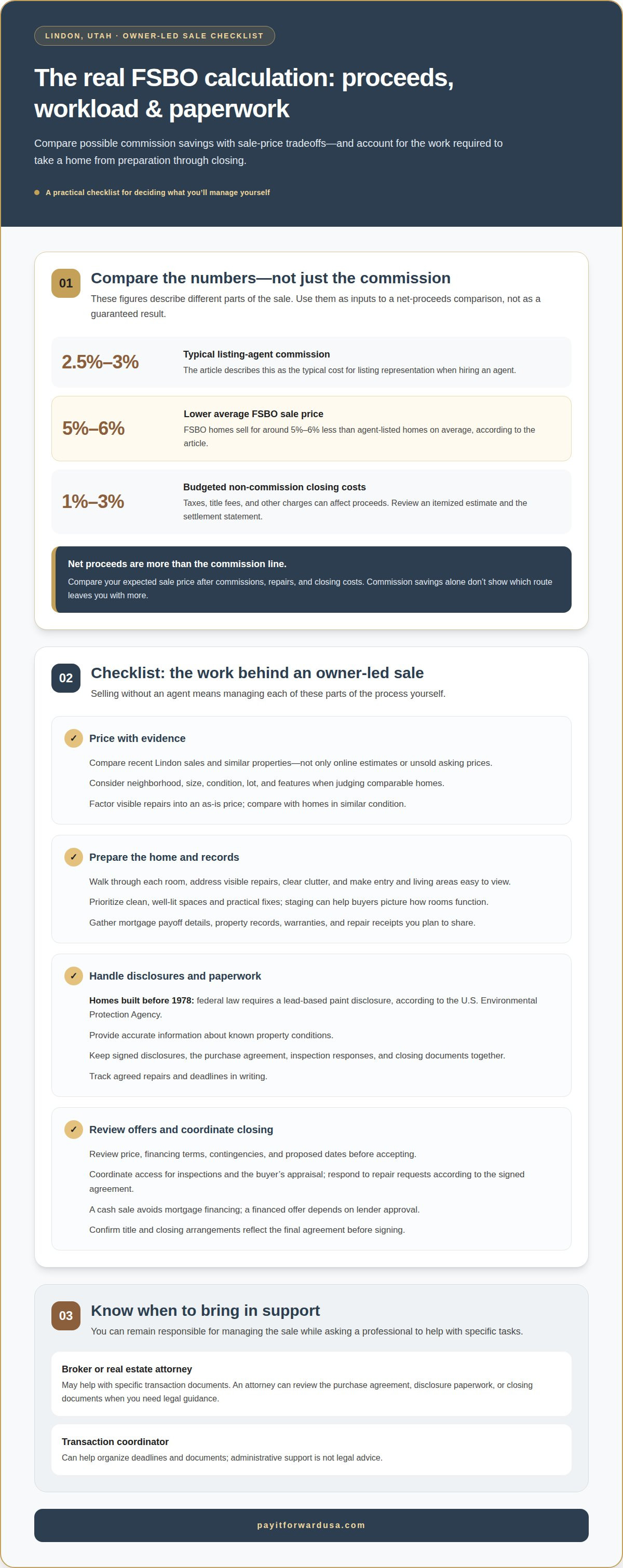
- Compare the likely net proceeds. Selling by owner can avoid a listing-agent commission, while hiring a real estate agent typically means paying 2.5%-3% of the sale price for listing representation. FSBO homes sell for around 5-6% less than agent-listed homes on average, so compare your expected sale price after commissions, repairs, and closing costs. Commission savings alone don’t show which route leaves you with more.
- Account for the work behind the savings. To sell without an agent in Lindon, you handle pricing, marketing, buyer questions, offer terms, and deadlines yourself. The risk is missing a task or misjudging an offer’s financing, inspection conditions, or closing timeline. A broker or real estate attorney can help with specific transaction documents, while you remain responsible for managing the sale.
- Prepare the home with a focused checklist. Walk through each room, address visible repairs, clear clutter, and make the entry and living areas easy to view. Staging can help buyers picture how rooms function, but prioritize clean, well-lit spaces and practical fixes. Before listing, gather mortgage payoff details, property records, and any warranties or repair receipts you plan to share.
- Organize disclosures and paperwork. Federal law requires a lead-based paint disclosure for homes built before 1978, according to the U.S. Environmental Protection Agency. Keep signed disclosures, the purchase agreement, inspection responses, and closing documents together. Provide accurate information about known property conditions, and track every agreed repair or deadline in writing.
- Manage each offer through closing. Selling by owner means reviewing the price, financing terms, contingencies, and proposed dates before accepting. Coordinate access for inspections and the buyer’s appraisal, then respond to repair requests according to the signed agreement. A cash sale avoids mortgage financing, while a financed offer depends on lender approval. Confirm that title and closing arrangements reflect the final agreement before signing.
Pricing a home using comparable sales and online estimates
Build your asking price from recent Lindon sales, then use online estimates as a cross-check. Comparing similar properties can help you choose a price buyers can understand.
-
Review Recent Comparable Sales
Compare your home with similar properties that sold in the previous 60-90 days. Match neighborhood, size, condition, lot, and features, then note how each difference affects value. Zillow and other online estimates can give you a starting point, but they may not reflect your home’s updates or street-level differences. Avoid relying on one estimate or an asking price that hasn’t been tested by a sale.
-
Account for Repairs in an As-Is Sale
List visible repairs and decide whether to address them before setting an as-is price. Compare homes in similar condition, not just renovated properties with higher prices. An as-is sale tells buyers you’re not planning repairs, but you still need to describe known issues accurately. Be prepared for buyers to factor repair needs into their offers or inspection requests.
- Compare active listings and agent sales activity. Review nearby homes competing for the same buyers, then separate asking prices from completed sales. A high listing price shows what a seller hopes to receive, not what buyers agreed to pay. Look at the range of sale prices and the property features behind them. This gives you context to decide whether your asking price fits the neighborhood rather than simply matching the highest listing.
- Use an appraisal to test your price. An appraiser evaluates the property and comparable sales, giving you another valuation reference when online estimates vary or your home has unusual features. Treat the appraisal as evidence, not a guaranteed sale price. If you plan to adjust the asking price after a showing or buyer feedback, base the change on comparable sales and current competition. For a later purchase, review available homebuyer rebate details as part of your budget.
Legal requirements for selling without an agent in Utah
Handle the sale in a clear sequence: organize paperwork, understand transaction costs, and decide where expert support would help. Selling independently doesn’t remove your responsibility to manage each step.
-
Review Taxes, Title Fees, and Closing Costs
Ask for an itemized estimate of seller costs before accepting an offer. Non-commission closing costs are often budgeted at approximately 1%-3% of the sale price; property taxes, title fees, and other charges affect your proceeds too. Review the settlement statement to see how taxes are prorated and which title or closing charges you’ve agreed to pay. Don’t calculate your net proceeds from the offer price alone.
-
Consider Legal or Transaction Support
Use a real estate attorney to review the purchase agreement, disclosure paperwork, or closing documents if you need legal guidance. A transaction coordinator can help organize deadlines and documents, but administrative support is not legal advice. Choose support based on the tasks you need handled.
- Match the selling approach to the property. A straightforward sale may suit homeowners who can manage showings, photos, buyer questions, and paperwork. Inherited homes, substantial damage, or complicated ownership can add decisions about repairs, signatures, and timing. Note the property’s condition and identify everyone who must participate before setting your process. Keep records together so buyers receive consistent information.
- Account for tenants and compare representation. For a rental home, organize lease details and coordinate showing access with tenants. Before choosing FSBO or hiring a realtor, weigh the time you can devote to buyer communication, offer review, and closing tasks. If you interview an agent, compare the proposed services, marketing plan, communication expectations, and commission terms. Select the approach that fits the property and the work you’re prepared to manage.
Can I list on the MLS without an agent?
Yes. A homeowner can use a flat-fee MLS service to submit a listing without hiring a full-service listing agent. Choose your exposure route, prepare accurate listing details, and plan how you’ll manage the transaction afterward.
-
Choose an MLS or FSBO Platform
Decide whether you want a listing on the Multiple Listing Service, an FSBO website, or both. FSBO sites let you publish property details directly, while an MLS listing can make the home visible to real estate professionals using that system. Twenty percent of FSBO sellers used the MLS website to market their homes. Compare what each platform publishes and how buyers can reach you.
-
Arrange a Flat-Fee MLS Listing
Choose a flat-fee MLS service if you want MLS exposure while managing the sale yourself. Prepare the property address, asking price, description, photos, and showing instructions before submitting the listing. Review every field for accuracy, especially the home’s features and transaction terms. Confirm how you’ll receive buyer inquiries and make permitted changes after the listing goes live.
-
Use the Multiple Listing Service
Once the MLS listing is active, respond promptly to inquiries and coordinate showings directly. Keep a record of appointments, buyer questions, and feedback that may inform a price adjustment. An MLS listing doesn’t negotiate the purchase contract or manage the closing for you. Review each offer’s price, financing, contingencies, and proposed dates before deciding how to proceed.
- Connect exposure to your sale plan. Before publishing, make sure the asking price aligns with comparable sales and your preferred transaction timeline. Keep the final listing details consistent across MLS and FSBO platforms, so buyers see the same estimate, features, and showing instructions. After accepting an offer, track contract deadlines through appraisal and closing. Explore Utah MLS listing options if you want MLS exposure while handling buyer communication and sale decisions yourself.
Pay It Forward Realty offers flat-fee MLS listing options for Utah homeowners who want market exposure while managing their own sale. Choose the plan that suits your listing approach and how you want to manage the process.
Selling and buying involve different decisions, so consider your listing needs separately from your purchase plans.
Explore the options and decide whether an MLS listing fits your next step. Visit Pay It Forward Realty to learn more.
Choose the Sale Plan You Can Manage
Before putting your Lindon home on the market, decide how you’ll handle the work as well as the costs. Make a simple plan for responding to inquiries, scheduling showings, reviewing offers, and organizing transaction paperwork. Consider who can help you keep track of deadlines if your schedule changes. A clear division of responsibilities can make an owner-managed sale easier to run from listing day through closing.
If you want MLS exposure while keeping control of buyer communication and decisions, explore a listing option that fits your approach. For homeowners who would rather have an agent manage the sale, compare that level of representation against the time and tasks you’re prepared to take on. Your best next step is the one that matches your priorities and capacity, not simply the most familiar route.
Ready to explore your options for selling a home in Lindon, Utah, without an agent? Contact Pay It Forward Realty to discuss a listing path that fits your plans. Take the next step with confidence and keep your sale moving on your terms.
Frequently Asked Questions
How quickly can I sell my house?
The time depends on finding a buyer and completing their purchase. In a slower market or with an incorrect asking price, an owner-led sale can take 60-90+ days. After an accepted offer, a cash purchase may close in 7-14 days, while a financed purchase typically takes 30-45 days. Set expectations around both marketing time and the buyer’s financing and closing process.
Can You Sell Your Home Without a Realtor?
Yes. Utah homeowners can legally sell without a realtor, taking responsibility for marketing, inquiries, negotiations, and transaction coordination themselves. For example, an owner can handle showings directly while using an MLS listing service for exposure. The key decision is how much of the sale you want to manage personally, from answering buyer questions to tracking contract deadlines.
How Much Can You Save?
Potential commission savings depend on the sale price, negotiated commission, and any buyer-agent compensation you choose to offer. As an example, eliminating the real estate agent can save $18,000 in commissions on a $300,000 home. Compare that potential reduction with other sale expenses and the final offer. A lower sale price can offset commission savings, so focus on your estimated net proceeds.
How do I handle the buyer's agent if they have one?
Review the offer’s terms and discuss buyer-agent compensation as part of the negotiation. The seller decides whether to offer compensation, and the amount can be negotiated rather than assumed. Read the purchase agreement carefully to understand any proposed payment, conditions, and deadlines. Keep the agreed terms in writing so compensation is clear before you accept and proceed with the transaction.
What disclosures are required when selling without a realtor?
Federal law requires a lead-based paint disclosure for homes built before 1978, according to the U.S. Environmental Protection Agency. Gather the applicable disclosure paperwork and property records before reviewing offers, so buyers can receive accurate information. Keep copies of documents you provide and signed forms with the purchase agreement. Selling without a realtor doesn’t remove disclosure requirements that apply to your property.
Which Option Is Best for Selling Without a Realtor in Utah?
The best fit depends on your priorities: direct FSBO marketing gives you control, while a flat-fee MLS listing can add MLS exposure as you manage the sale. If you already have a buyer, direct negotiation may suit your situation. If you need wider listing visibility, consider the MLS route. Choose based on your marketing plan, available time, and comfort handling offers and paperwork.


